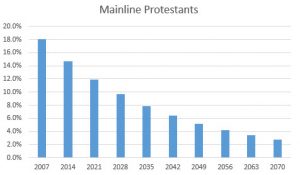
In 2007 the Pew Research Center conducted their initial U.S. Religious Landscape Study. The 2014 edition, published earlier today, shows Christianity declined by 8% in America over the last seven years (78.4% to 70.6%). Allowing for the margin of error, this means the number of Christian adults in the U.S. has shrunk by somewhere between 2.8 million and 7.8 million. Decline Impacts All Christian Traditions Mainline Protestants and Catholics top the list for Read More …
mainline
From Mainline to Sideline to Oldline (#1526)

I grew up in a Mainline Protestant congregation. The congregation I was raised in belonged to one of the seven sisters of Mainline American Protestantism: the Congregational Church (now a part of the United Church of Christ), the Episcopal Church, the Evangelical Lutheran Church, the Presbyterian Church (USA), the United Methodist Church, the American Baptist Convention, and the Disciples of Christ. While my childhood congregation has remained a part of the Presbyterian Church (USA), Read More …
Christian Belief in a Personal God (#1489)

Tobin Grant recently wrote an insightful article calling attention to the fact that just because American Christians believe in God does not mean that they believe in is a personal God. Using data from the 2007 Religious Landscape Survey Grant provides graphical representations of what percentage of American Christians in each of 43 religious traditions believe in God followed by another illustrating what percentage of these believe in a personal God. Focusing on belief in a personal God Read More …
Stop Redecorating & Start Making Real Changes (#1476)

Tom Ehrich, a writer and Episcopal priest, recently slammed the work of an Episcopal task force. For him, the task force's focus on what can be done at the level of the denomination "seems a bit like redecorating and recalibrating the home office of a company in which the home office plays a minor role." The time for that type of change ended decades ago. The mainline denominations (a group that includes Episcopalians) are a shell of what they once were, and are now "down more than Read More …
Shifts in Religious Affiliation (1972-2012) (#1464)
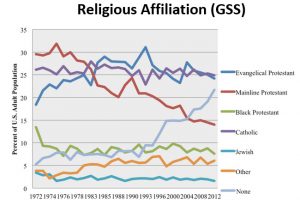
The changing role of religion in American culture is a popular topic of conversation among religious leaders. Those leaders situated within Mainline Protestantism (a tradition I claim as my own) are talking more openly than ever before about decline. Even the names used to describe the tradition increasingly recognize that the decline is both about diminishing numbers of adherents (Oldline) and a more marginalized role (Sideline). While I am encouraged by increased attention Read More …
End of an Era (#1383)

Travis Scholl, managing editor of theological publications at Concordia Seminary - St. Louis, recently reflected on what some view as signs that we are at or nearing the end of an era. More specifically, he mentioned two recent news stories: (1) Alban Institute's decision to shut its doors and (2) the Unitarian Universalist Association's decision to sell its historic headquarters atop Beacon Hill in Boston. Scholl places these changes in their appropriate historical Read More …
America the Religiously Diverse (#1328)
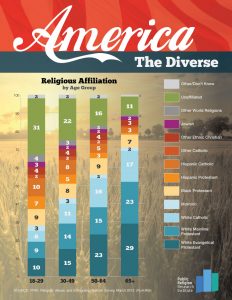
Last week's graphic of the week from the Public Religion Research Institute is titled America the Diverse. In the days since it was posted, I have returned to it several times and referenced it in multiple conversations. So What? The information contained on this graphic isn't news to those who follow generational trends. It is, however, important data for congregational leaders to consider as they plan for the future. Currently, I serve two mainline congregations comprised Read More …
Leaving Your Denomination (#1312)

Recently, the United Methodist Church has been in the media spotlight over the departure of clergy. Most such publicity has focused on those who have chosen to perform same-sex weddings despite the denominations official position prohibiting such. While such acts are likely to continue to attract attention and may ultimately help lead to reform, the denomination's position on who clergy may marry is not the only reason clergy are leaving the denomination. Jack Kale, pastor of the Read More …
The Decade of Christian Decline (#1268)
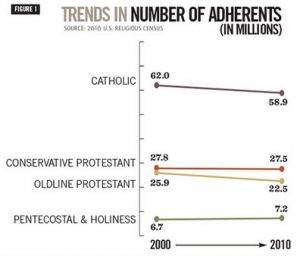
2000-2010 can best be labeled as a decade of decline for American Christianity. David Roozen's recent piece in the Christian Century provides an important look at just how rapid the decline was for conservative/evangelical Protestants, mainline/oldline Protestants, and Roman Catholics. As a percentage, the declines were oldline/mainline: 13% Catholic: 5% conservative/evangelical: 1% So What? After decades of progressive Christianity, it should not be surprising to see Read More …
Declining Denominational Budgets (#1239)
For years, mainline denominations have been facing declining budgets at the denominational level. The United Church of Christ has not been exempt from the trend. While the 2014 budget of $25.3 million reflects a decline of nearly 9% ($2.2 million) from 2013, it still includes a shortfall of $2.3 million. More specifically the 2014 budget dollars are allocated as follows: Wider Church Ministries: $8.6 million, Office of the General Minister and President: $7.3 million, Local Read More …