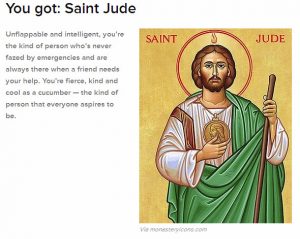
A few days ago I finally gave in and submitted my answers to a rather unusual (ok, I will admit it: somewhat bizarre) quiz making the rounds on social media. If you have a sense of humor and enough patience to answer ten questions, then you can learn which one of Jesus' disciples you are most like. It turns out that, according to my responses to this quiz, my New Testament alter ego is Saint Jude. So What? While being asked to choose a color and choose a month as a part of the Read More …
Trends
So Many Pastoral Stunts (#1333)
David Gibson's recent Religion News Service article listed 12 stunts performed by pastors that received significant publicity, including bishops pretending to be homeless, a week of congregational copulation (followed up with a bed in), living the bible as literally as possible (including Rachel Held Evans' A Year of Biblical Womanhood), eating foods that can be purchased on a "food stamp" budget, and losing weight for the Lord. So What? Each of these stunts was designed Read More …
Why Facebook? (#1332)
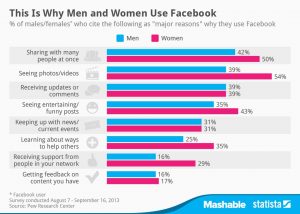
According to a recent Pew Research survey, men and women share many "major reasons" for using Facebook. The top reason women use Facebook is to see photos/videos whereas the top reason men use Facebook is that it allows them to share with many people at once. So What? Whether you are a relative newcomer to Facebook or have been a part of this social community for many years, it is likely your own major reasons for using it have evolved over time. While some of the change may have Read More …
Reality Check: Religious Non-Affiliation (#1331)
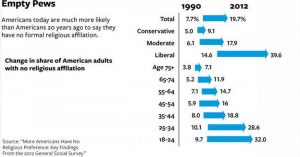
In recent months I have had more conversations than ever before about the continued rise of the nones (the increase in the percentage of American adults without formal religious affiliation). While there is plenty of data out there showing that the percentage of nones is increasing (for example:"America the Religiously Diverse" and "Rise of the Nones") it doesn't answer the number one assumption I hear: as people age they become more religious. This assumption sounds logical and Read More …
America the Religiously Diverse (#1328)
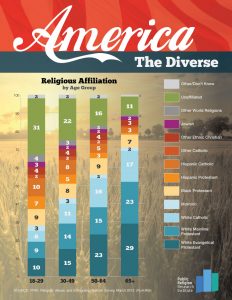
Last week's graphic of the week from the Public Religion Research Institute is titled America the Diverse. In the days since it was posted, I have returned to it several times and referenced it in multiple conversations. So What? The information contained on this graphic isn't news to those who follow generational trends. It is, however, important data for congregational leaders to consider as they plan for the future. Currently, I serve two mainline congregations comprised Read More …
Experiential Intimacy (#1327)
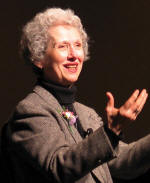
Phyllis Tickle's latest book, “The Age of the Spirit: How the Ghost of an Ancient Controversy is Shaping the Church,” is near the top of my stack of books I hope to read soon. In a recent interview about this book with Jonathan Merritt, Tickle shared that the trend is toward a "greater experiential intimacy" with the Holy Spirit. Tickle says: Additionally, we’re seeing a need to experience the Spirit everyday and a belief in the accessibility of the Spirit. Most Christians 100 Read More …
Goodbye 1980s (#1326)
I don't remember when I was last in a Radio Shack. I do know it has been well over a decade since I last shopped there. As such, I am not in position to know just how significantly they have evolved to meet the changing demands of the marketplace. I did, however, enjoy watching their Goodbye '80s commercial during the Super Bowl. So What? As I reflected on this commercial, I couldn't help but reflect on the parallels between the mainline/oldline/sideline church and Radio Read More …
Marketing, Mission & Money (#1324)

Last weekend First Congregational Church (Winter Park, FL) welcomed Cameron Trimble and Michael Piazza of the Center for Progressive Renewal. They led a workshop for leaders from churches across Florida focused on marketing, mission and money - three of the most challenging issues facing the church today. While I was unable to attend, I benefited from it by reading some of the quotes Sarah Lund, Regional Minister of the Western Region of the Florida Conference of the United Church of Read More …
Too Many Clergy? (#1320)
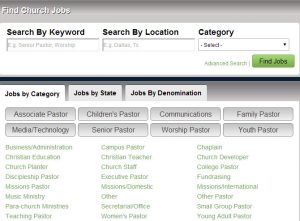
How many clergy are too many? I don't have an answer, but do think the question is important to discuss at all levels of the church. I have heard from several colleagues and from members of search committees just how different the search process has become in recent years. Perhaps this is why (or at least a part of the reason why): In the 1950s there were roughly the same number of ministers as there were U.S. churches. Now there are almost two ministers for every church, according Read More …
Online Church Shopping (#1319)

David Odom, Executive Director of Leadership Education at Duke Divinity School, recently blogged about the increasing tendency of shoppers, including church shoppers, to shop online. When it comes to those who are looking for a church, Odom notes that they "frequently visit the congregation online by watching services, reading about services and asking questions." This activity is a part of the screening process many now use in making a decision about whether or not to attend Read More …