It is widely known and frequently reported that the United States of America is becoming less and less Christian when considering the number of Americans who self-identify as Christian. For example, earlier this month I posted Christianity Declines by 25% in America, exploring the decline over the last 50 years.
Current Breakdown
Just how many Americans are affiliated with each religion?
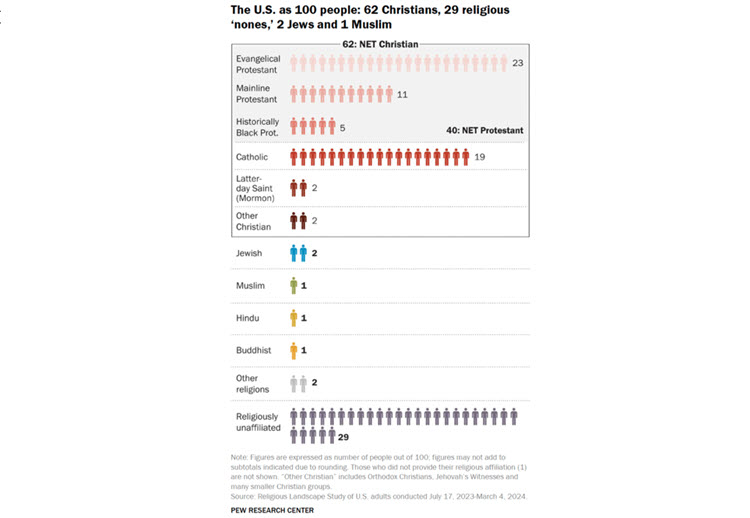
To answer this question, Becka A. Alper and Aleksandra Sandstrom frame the answer in a way that is easy for most readers to process. Recognizing that many people struggle with understanding very large numbers, they opt to present the Pew Research Center’s 2023-24 Religious Landscape Study data as if America were a town of 100 people.
If The US Were 100 People
In this scenario,
- Christian – 62
- Unaffiliated – 29
- All Religions Other than Christian – 7

What Sort of Christian?
While 62% of the population identifies as Christian it is important to note that there is considerably diversity within Christianity’s many traditions and denominations. Seeking to group America’s Christians into existing sociological subcategories yields the following breakdown:
- Evangelical Protestants – 23
- Mainline Protestants – 11
- Catholics – 10
- Historically Black Protestant – 5
- Church of Jesus Christ of Latter-day Saints (widely known as Mormons) – 2
- All other Christian groups, including Jehovah’s Witnesses – 2
Distribution
Notably the current religious affiliation of American adults varies considerably based upon age and geography. This shows up in many ways, including
- 4x more Protestants in the South than in the Northeast (a combination of Evangelical and Mainline)
- 4x as many religiously unaffiliated 30-49 year olds compared to those ages 65 and above
- 2x as many Catholic 50-64 year olds compared to those ages 18-29
So What?
For those shaping the future of American Christianity, including clergy and lay leaders, the following three sentences from Alper and Sandstrom’s analysis deserve considerable attention:
“In our hypothetical town, more Christians would be ages 50 and older (35) than under 50. Eighteen Christians would be in their 30s and 40s, while nine would be between ages 18 and 29. The age balance would be reversed for religious “nones,” with 20 under age 50 and fewer than 10 ages 50 and older.”