Mainline Protestant decline is no longer debated. It is measured, tracked, and widely acknowledged. As a lifelong member of this tradition and an ordained minister within it, I have spent years paying close attention to what is happening and asking why.
Nearly two years ago, I gathered much of that work into a single place: My Religion is Dying: A Deep Dive into Mainline Decline. That post serves as a hub, linking to more than 50 additional posts that explore both broad Mainline trends and denomination-specific patterns of decline.
Decline in the ELCA
The Evangelical Lutheran Church in America (ELCA), one of the seven historic Mainline denominations, offers a striking case study. Formed in 1988 through the merger of the American Lutheran Church, the Association of Evangelical Lutheran Churches, and the Lutheran Church in America, the ELCA has since lost nearly half its membership.
In 1988, the denomination reported 5,251,534 members. By 2023, that number had fallen to 2,793,899. This represents a loss of more than 2.4 million people over 35 years.
Over the last thirteen years I have written about this decline from multiple angles, including:
- ELCA Membership Cut in Half (2024)
- The ELCA is Missing 4 Million People! (2023)
- From 5 Million to 4 Million (2013)
- So Many Dwindling Congregations (2013)
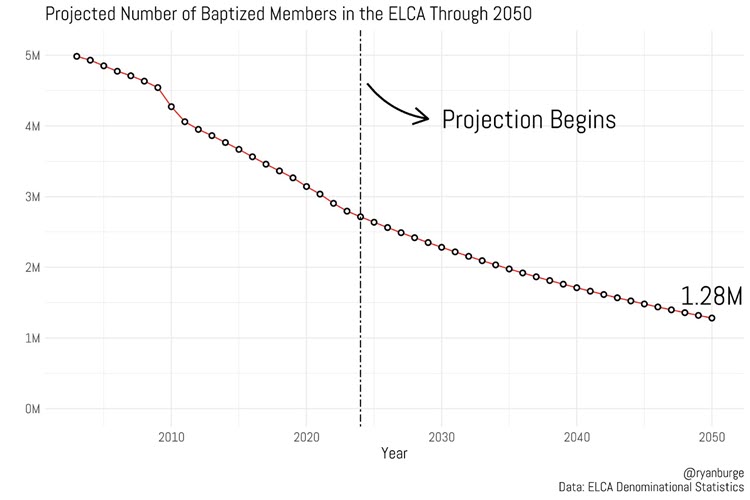
Looking ahead, current projections extend the same trajectory. Ryan Burge, a scholar widely recognized as one of the most prolific and insightful commentators on the statistical shifts in American religion, predicts that just as the ELCA has shrunk by half since its founding, it may be half its current size again by 2050. (Burge is also the author of the only book published in 2026 to have been rated as 5+ by So What Faith.)
So What?
In recent years, decline in the ELCA and across the Mainline has followed a largely predictable pattern. Absent major disruption, there is little reason to expect that trajectory to change between now and 2050. The primary exception has been moments when denominational decisions prompt congregations and members to leave, as the ELCA experienced in 2009.
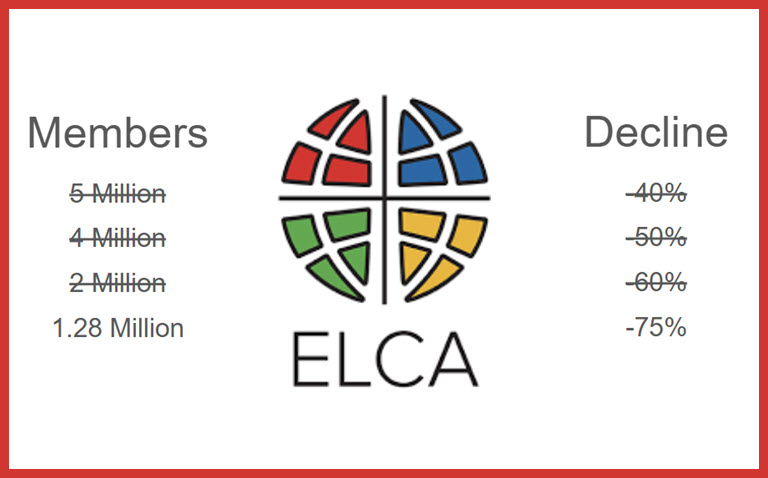
If membership falls to 1,280,000 by 2050, the ELCA will have declined by 75.6 percent in just 62 years.
The question I keep returning to is, “Based on what you see in the ELCA and in broader religious trends, will membership in 2050 be above or below 1,280,000?” What factors most shape your answer?