The best new books I’ve read in the last month are
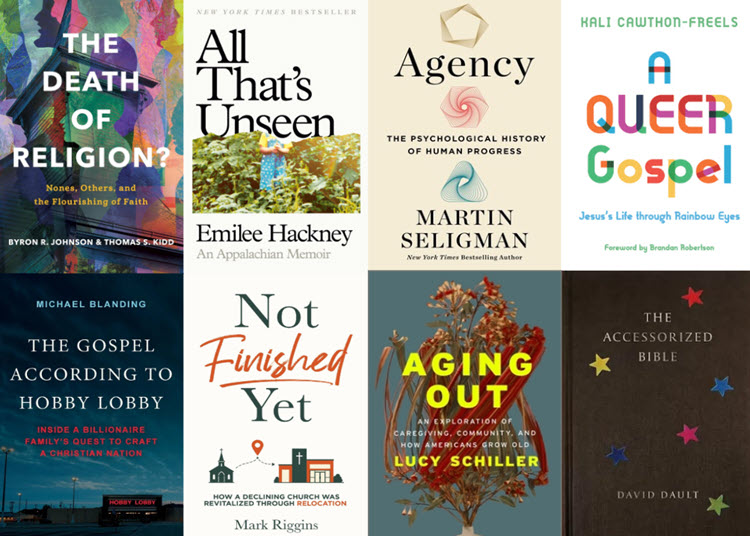
- (5+) The Death of Religion: Nones, Others, and the Flourishing of Faith by Byron R. Johnson and Thomas S. Kidd (B&H Academic, 2026)
- (5.0) All That’s Unseen: An Appalachian Memoir by Emilee Hackney (Penguin Press, 2026)
- (5.0) Agency: The Psychological History of Human Progress by Martin Seligman (Simon Acumen, 2026)
- (4.5) A Queer Gospel: Jesus’s Life through Rainbow Eyes by Kali Cawthon-Freels (Nurturing Faith, 2026)
- (4.5) The Gospel According to Hobby Lobby: Inside a Billionaire Family’s Quest to Craft a Christian Nation by Michael Blanding (Public Affairs, 2026)
- (4.0) Not Finished Yet: How a Declining Church was Revitalized Through Relocation by Mark Riggins (Rainer Publishing, 2026)
- (4.0) Aging Out: An Exploration of Caregiving, Community, and How Americans Grow Old by Lucy Schiller (Flatiron Books, 2026)
- (4.0) The Accessorized Bible by David Dault (Yale University Press, 2026)
The Death of Religion
The Death of Religion joins The Vanishing Church: How the Hollowing Out of Moderate Congregations is Hurting Democracy, Faith, and Us as the only two books to be rated 5+ this year on So What Faith. By comparison, just three books received that rating in 2025.
In recent years there have been dozens of well-researched books chronicling the decline in American Christianity, often with particular emphasis given to Mainline Protestant denominations since the decline began there before becoming more widespread. The Death of Religion offers a provocative challenge to the way that decline is typically understood.
Byron R. Johnson has spent decades researching religion and its social impact and serves as the founding director of the Institute for Studies of Religion and distinguished professor of the social sciences at Baylor University. Thomas S. Kidd is a historian of American Christianity whose work has focused particularly on evangelicalism and American religious history. Kidd recently joined Johnson at Baylor as senior research scholar in the newly formed institute. Together, they bring substantial research and historical perspective to a question that deserves more attention: How much of American Christianity has actually disappeared, and how much has simply moved or changed?
One of the book’s distinctive contributions is its use of recent findings from the Global Flourishing Study, a multiyear study of human and societal well-being. Johnson and Kidd argue that conventional surveys can oversimplify the religious lives of respondents, particularly those who identify as religiously unaffiliated, or “nones.” Their research points to faith remaining resilient and consequential, with religious participation continuing to be associated with individual well-being and stronger communities.
A key argument is that the decline of American Christianity may be less extensive than conventional measures suggest because much of the research used to measure religious affiliation does not adequately capture the present religious marketplace, including newer, independent, and nondenominational congregations. Johnson and Kidd argue that people leaving established denominations are not necessarily leaving Christianity. Some are switching congregations or forms of Christian community that traditional surveys fail to capture. Sociologically, this is religious switching. In other words, what looks like religious decline may sometimes be movement from one expression of Christianity to another.
That doesn’t mean the decline of established denominations isn’t real. It clearly is. Instead, the authors suggest that denominational membership statistics may not provide as accurate or complete a picture of American Christianity as many assume.
This matters for all who follow the Way of Jesus and is of particular interest to leaders within local congregations and in networks or denominations. If the authors are right, understanding the future of Christianity requires us to look beyond denominational membership numbers and pay closer attention to where people are actually finding faith and experiencing Christian community.