I am a huge fan of the local church. After 30 years of serving congregations, I have seen firsthand the good that local churches can do.
Over the last 30 years, I’ve served 11 congregations affiliated with 5 denominations: Christian Church (Disciples of Christ), Evangelical Lutheran Church in America (ELCA), National Association of Congregational Christian Churches, Presbyterian Church (USA), and United Church of Christ (UCC) in the Dallas – Arlington – Fort Worth metropolitan area of North Texas and in the Naples – Marco Island – Fort Myers area of Southwest Florida.
Local Churches Cannot Do It All
I am also very aware of the practical limitations of most local churches. Most congregations are not equipped to be their community’s primary provider of basic needs services, such as food pantries or clothing closets. And when several churches in the same geographic area each offer a small version of the same service, it can be difficult for neighbors in need to know where to go, when services are available, or what each congregation provides.
A more effective model, one that can offer both better stewardship of resources and greater accessibility for neighbors in need, is for churches to work together to serve their community. One way to do this is through a nearby faith-based non-profit that coordinates and carries out this work.
A Helpful Thread
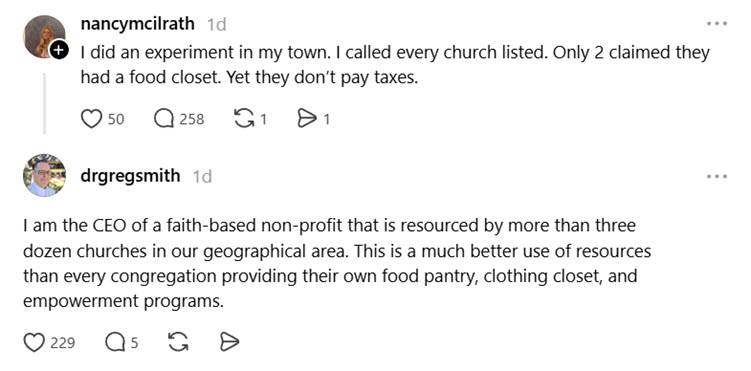
Yesterday, I responded to a post from someone who had been calling local churches to find out where people could get food. They were discouraged that only two churches said they had food available on site.
I responded:
I am the CEO of a faith-based non-profit that is resourced by more than three dozen churches in our geographical area. This is a much better use of resources than every congregation providing their own food pantry, clothing closet, and empowerment programs.
Stronger Together
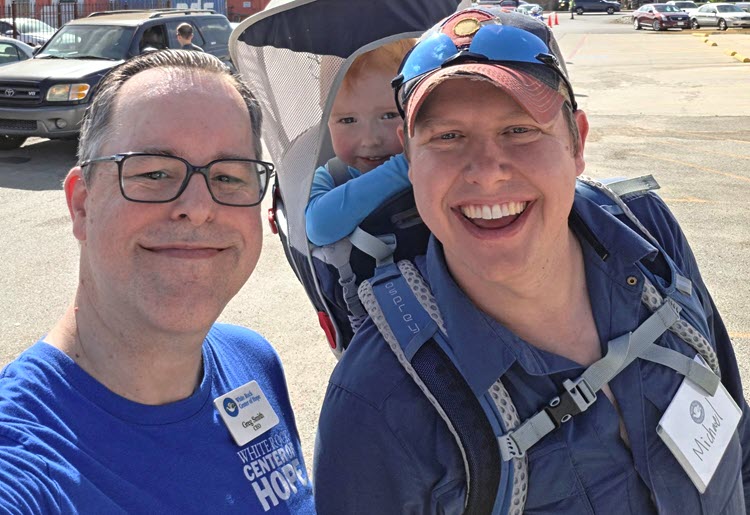
Since 2021, I have served as CEO of White Rock Center of Hope in Dallas, Texas. This organization was founded in 1988 by 13 congregations in East Dallas. These faith communities shared little in common beyond geography. They were of different sizes, affiliated with different denominations, and utilized different approaches to community ministry. They did not need to agree on everything. They simply shared a commitment to their neighbors and a belief that they could accomplish more together.
Nearly 40 years later, that vision has grown dramatically. This year, more than 16,000 unique people will receive Hope in a very practical way through one of Hope’s basic needs programs and more than 500 people will take steps toward economic self-sufficiency by participating in one of Hope’s empowerment programs. All of this is possible thanks to more than 1,500 community volunteers, the majority of whom first learned about Hope through one of the more than three dozen congregations that presently support Hope.
When people need help in East Dallas with life’s basics, Hope is here. Neighbor Services – including the Food Pantry and Clothing Closet – are open Monday through Friday from 9:00am to 1:00pm. Additionally, Hope provides a drive through food distribution on the first and third Saturdays of the month at 10:00am.
So What?
We are stronger together.
Together, we create a deeper impact. Together, we steward our resources more effectively. And together we make it easier for our neighbors to find the help they need.
White Rock Center of Hope does not do many of the things local churches are uniquely qualified and positioned to do well. Hope does not offer worship services, Bible studies, or Christian education and discipleship. Instead, Hope encourages neighbors to get connected with a local congregation.
That’s the beauty of partnership. It means that the local church remains the local church and faith-based non-profits remain faith-based non-profits. And, it enables neighbors in need to receive practical help from a community that has decided to work together.
Hope and many faith-based non-profits like it around the country provide a way for neighbors to serve neighbors. That work often begins with local churches and other houses of worship, but it does not have to end there.
Perhaps the question for churches isn’t simply, “What can we do?”
Perhaps it is, “What can we do together?”