The best new books I’ve read in the last month are
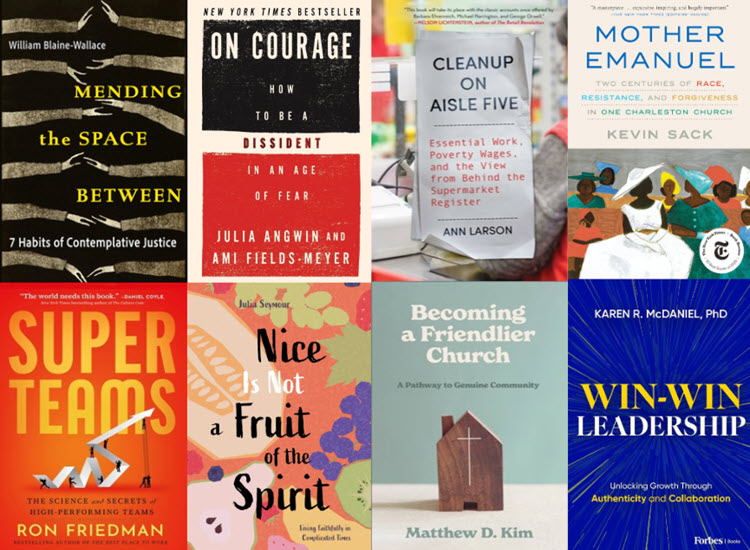
- (5.0) Mending the Space Between: 7 Habits of Contemplative Justice by William Blaine-Wallace (Orbis Books, 2026)
- (5.0) On Courage: How to be a Dissident in an Age of Fear by Julia Angwin and Ami Fields-Meyer (Mariner Books, 2026)
- (5.0) Cleanup on Aisle Five: Essential Work, Poverty Wages, and the View from Behind the Supermarket Register by Ann Larson (Atria, 2026)
- (4.5) Mother Emmanuel: Two Centuries of Race, Resistance, and Forgiveness in One Charleston Church by Kevin Sack (Crown, 2026)
- (4.5) Super Teams: The Science and Secrets of High-Performing Teams by Ron Friedman (Simon & Schuster, 2026)
- (4.5) Nice is Not a Fruit of the Spirit: Living Faithfully in Complicated Times by Julia B. Seymour (Pilgrim Press, 2026)
- (4.0) Becoming a Friendlier Church: A Pathway to Genuine Community by Matthew D. Kim (Baker Books, 2026)
- (4.0) Win-Win Leadership: Unlocking Growth Through Authenticity and Collaboration by Karen R. McDaniel (Forbes Books, 2026)
5 Star Trio
Prior to this list, I had rated only six books as 5.0 or higher so far in 2026.
That makes this month’s trio especially noteworthy. Although these books examine very different subjects, each offers timely wisdom for navigating today’s world with greater courage, compassion, and purpose.
William Blaine-Wallace’s Mending the Space Between: 7 Habits of Contemplative Justice is the strongest new faith-based leadership book I have read this year. Rather than treating contemplation and justice as competing priorities, Blaine-Wallace shows how deep spiritual practices can sustain long-term engagement with the world’s most pressing challenges. Progressive Christians seeking a framework for faithful action that avoids both burnout and disengagement will find a compelling vision of discipleship grounded in both reflection and action.
Julia Angwin and Ami Fields-Meyer’s On Courage: How to Be a Dissident in an Age of Fear arrives at an especially important moment. Drawing on extensive interviews and careful reporting, the authors explore how ordinary people can resist intimidation, speak truth, and act with integrity when social, political, or organizational pressures encourage silence. Clergy and lay leaders wrestling with how to lead faithfully in polarized and uncertain times will find both inspiration and practical guidance.
Ann Larson’s Cleanup on Aisle Five: Essential Work, Poverty Wages, and the View from Behind the Supermarket Register turns readers’ attention to the often invisible workers who keep our communities functioning. Through her firsthand experience behind the register, Larson reveals the economic realities facing grocery workers while offering a deeply human portrait of the people whose labor powers the modern food system. Readers committed to economic justice will come away with a richer understanding of both the dignity of this work and the structural forces that too often keep essential workers in poverty.
It is rare to encounter three books of this caliber in a single month. Each explores an important topic with depth, nuance, and clarity while remaining engaging from beginning to end. Strong ideas are matched by strong writing, making these books memorable reading and worthy of my 5.0 rating.