When discussing the numerical decline of a denomination, the conversation usually focuses on membership loss from its historic peak. While that is an important measure, it tells only part of the story.
An equally important question is this: How large is the average congregation today, and how many churches have become so small that their long-term viability is in doubt?
Membership Continues to Decline
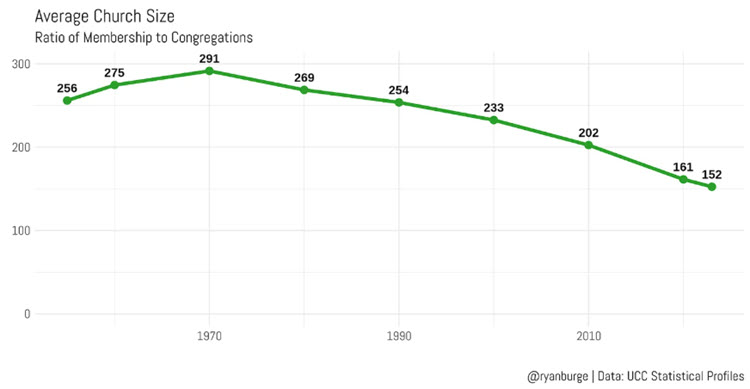
The average UCC congregation is now roughly half the size it was in 1970.
- 1970: 291 members per congregation
- 2024: 152 members per congregation
Using the denomination’s annual statistical reports, Ryan Burge illustrates this long-term decline in average congregational size.
Worship Attendance Has Reached Historic Lows
Membership statistics tell only part of the story. Weekly participation has also declined dramatically.
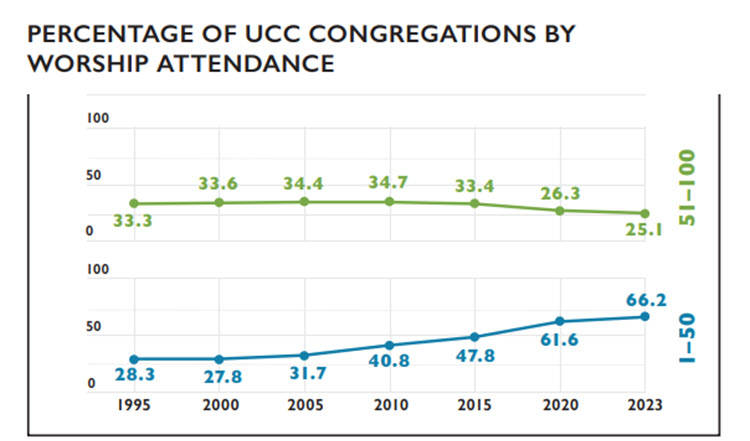
Back in 2016, I noted that 47.8% or nearly half of all UCC congregations averaged 50 or fewer people in worship each week.
Today, that figure has grown to 66.2% or roughly two out of every three congregations.
The broader picture is even more sobering.
More than nine out of every ten UCC congregations (91.3%) now average 100 or fewer worshipers each week. At the other end of the spectrum, only 0.5%, about one congregation in 200, averages more than 400 people in weekly worship.
So What?
One way to appreciate how dramatically the denomination has changed is to consider a simple thought experiment.
If UCC membership were to remain exactly where it is today, nearly 47% of congregations would have to disappear for the denomination to return to the 1970 average of 291 members per congregation.
I am not suggesting that this will happen. Instead, this comparison helps illustrate just how dramatically the relationship between membership and the number of congregations has shifted over the last half-century.
The more pressing reality is that as membership continues to decline, average congregational size continues to shrink, creating an ever-growing share of churches that are struggling with limited financial resources, aging memberships, and too few new participants. As these trends continue, many congregations will be forced to make increasingly difficult decisions about their future.
Unless those trends change significantly, it seems likely that hundreds of UCC congregations will spend the next decade discerning whether God is calling them to continue their current ministry, to merge with another congregation, to reimagine their mission, or to conclude their ministry.
Healthy congregations recognize that every church has a life cycle. Faithful stewardship sometimes means embracing holy closure while a congregation still has the financial resources, members, and energy to make intentional decisions about its legacy. Choosing that path before every option has been exhausted allows a congregation to celebrate its ministry, bless those who will carry its witness forward, and leave a lasting impact on its community.