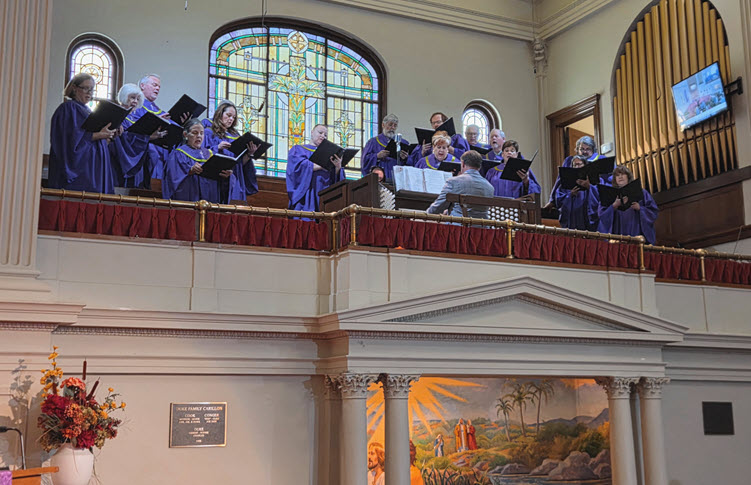
Today I preached my second sermon as the Interim Senior Minister of First Christian Church (Disciples of Christ) in downtown Fort Worth, Texas (you can learn more about this new role here).
ermon
My message, “The Story Isn’t Finished” is based on Ezekiel 37:1-14 and John 11:1-45.
You can watch the sermon below or read the manuscript.
Excerpt
I remember lying in the back of an ambulance, unable to see, uncertain about my injuries, and wondering if perhaps this was going to be the end of my story. In that moment, the future I had imagined for myself felt impossible.
Perhaps you’ve been there. Not in an abstract way. Not as part of an academic inquiry or a theological puzzle. But, rather, in a deeply personal lived experience that arrived as an unexpected life challenge, bringing into question the future you had planned. Something so abrupt that you could only ask, “Is this where my story ends?”
This hard question is one we usually don’t seek out, but it is also one we all must confront. And, it is a question that we should ask of both of this morning’s texts. In both Ezekiel and John, today’s stories begin with a situation that feels like it is the end.
Let’s start with Ezekiel. No matter how you look at it, this is a bizarre scene. It’s also one of the most unforgettable images in the Bible. The prophet is placed in the middle of a valley that is filled with bones. Dry bones. Long dead bones.
And, God gets things going with a question that seems inappropriate and goes well beyond what we have been taught is okay to ask when surrounded by so much death. God asks, “Can these bones live?”[1]
Ezekiel gives what might be the most honest answer in the Bible, “Lord God, only you know.”[2]
Dr. Brent Strawn, Professor of Old Testament at Duke Divinity School explains, “The second person independent pronoun “you” in this verse is unnecessary in Hebrew and may signal emphasis in some fashion. Perhaps a paraphrase that approaches the tone is: “You may know the answer to that question, Lord; I definitely don’t!”[3]
Let’s be real. From the human perspective, the answer is a hard “no.” A bunch of bones that have long been detached from one another and separated from bodies that once contained them cannot come back to life. That isn’t how gravesites work.
But in racing to offer this logical answer, we have missed something important. This story isn’t primarily about individuals. It is about a people. It is about a nation. Ezekiel is speaking to Israel in exile. . .
[1] Ezekiel 37:3, RSV
[2] Ezekiel 37:3, NCV
[3] Brent A. Strawn. Commentary on Ezekiel 37:1-14, Working Preacher, December 10, 2017, available from www.workingpreacher.org/commentaries/narrative-lectionary/ezekiel-valley-of-dry-bones/commentary-on-ezekiel-371-14-3