Last night I received "A Message from HSU President Eric Bruntmyer." Given Hardin-Simmons University's recent restructuring I opened the e-mail and read the message in its entirety. After an opening paragraph about serving students for 129 years and preparing for the next 129 years and a paragraph sharing that the 2019 freshman class is the second largest ever, the message contained these words: Today, February 7, the Hardin-Simmons University Board of Trustees concluded the first of three Read More …
Seminary
My Life in Ministry: The First 20 Years (#1802)
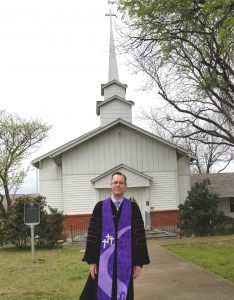
I went to college to prepare to enter vocational ministry. During seminary, I assumed that I would spend the rest of my working years in pastoral ministry in a local congregation. Experience Like many people in my generation who went straight from life as a traditional undergraduate student to seminary, my vocational path has broadened in recent years. After serving in long-term roles in local congregations from 2000 to 20012, I ventured into interim ministry beginning in 2013. Read More …
Growing Seminaries (#1547)
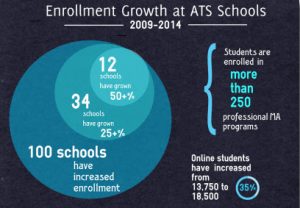
Nearly every regular reader of this blog is well aware that American Christianity has been in decline for many years. Given this reality one would expect that seminary enrollment would also be declining since this schooling is often required of those seeking ordination (and in traditions where such advanced degrees are not required they have long been an attractive and helpful professional credential). According to a new report from the Association of Theological Schools, more Read More …
Fully Online Seminary Education (#1207)

During the first 10 years of the 21st century, the number of students in higher education taking at least one online course nearly tripled (for more, check out "The Rise of Online Higher Ed"). There was also considerable growth in the number of fully online students. Just as the church tends to change more slowly than the culture at large, seminary education seems to shift more slowly than higher education in general. Like most pastors, I attended seminary in an era when online Read More …
Life After Seminary (#1100)
For generations, seminaries were primarily designed to train people for pastoral ministry. Today, less than half of all graduates of the typical seminary degree for pastors (master of divinity) plan to engage in full-time church ministry. According to the Association of Theological Schools the shift has taken place in just a few decades. At that time, over 90% of students planned to enter full-time church ministry. The percentage has declined ever since, reaching 52% by Read More …
Seminaries Lack Faculty Diversity (#1044)
While the topic of reforming the seminary experience has been popular for many years (for ideas forwarded by many leaders check out the Future of Seminary Education), it is atypical for such conversations to include expectations for faculty diversity. Even though I would have guessed this was an area in which improvement could be made, I was surprised by the latest statistics. Claudio Carvalhaes recently shared that the Association of Theological Schools reported the Read More …
Educational Debt – BS (#1030)
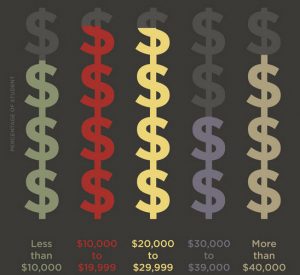
When I initially encountered Greg Henson and David Pohlmeier's new infographic on what incoming seminary students bring with them, I found myself gravitating toward the financial data. The data used to generate the graphic comes from surveys completed by 6,900 incoming students at 161 ATS schools during the 2011-2012 school year. Among the findings: 51% of all incoming students enter seminary with educational debt (the image at right shows the debt load of Read More …
Pastoral MBA (#0927)
While most Protestant denominations either require or strongly recommend those preparing for ministry as pastor earn a seminary degree (normally the Master of Divinity) few groups have established protocols requiring that academic preparation include significant training in business or organizational leadership. Since most congregations are small in size (approximately two-thirds have fewer than 200 members), pastors are often tasked with the daily oversight of the daily operations of the Read More …
Spong on Seminaries (#0830)
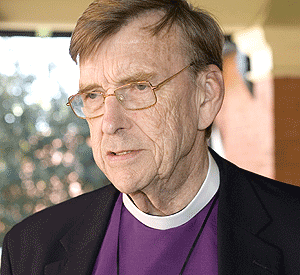
John Shelby Spong served as bishop of the Episcopal Diocese of Newark for 24 years before his retirement in 2001. In retirement, he has been a prolific writer and speaker. After teaching a weeklong intensive course at the Pacific School of Theology, he reflected on how that school has changed to more effectively meet the demands of preparing people for ministry in the early twenty-first century. He is hopeful that this institution's current intentions will Read More …
A Free Mainline Seminary Education (#0577)

Recently Louisville Presbyterian Theological Seminary announced that they will become the first mainline seminary to charge no tuition for "students in its master’s degree programs in divinity, marriage and family therapy and religion beginning in 2015." Rather than cutting costs or quality, the school intends to finance this initiative by increasing its endowment and decreasing the number of students admitted (moving from 150 to 130). So What? Many students begin their seminary Read More …